Introduction
In today's hyper-competitive digital landscape, the old saying "keep your friends close and your enemies closer" has never been more true. For any business — from a solo startup founder to a global enterprise — competitive tracking is a fundamental necessity.
A competitor's new feature, a sudden price drop, or a successful marketing campaign can influence your market share. The only way to stay ahead is to have a systematic approach to competitive intelligence.
In this guide, we break down the top platforms for competitor analysis and market intelligence. We'll compare their tracking functionality, pricing, and core strengths to help you build the ultimate competitive intelligence stack for data-driven decisions and market dominance.
Why Track Your Competitors?
Optimizing Your Marketing Spend
Your competitors have already spent millions figuring out what works and what doesn't. Competitive tracking allows you to piggyback on their investment, dramatically increasing your marketing ROI.
SEO Strategy: See which keywords your rivals rank for, which pages drive the most traffic, and where their backlinks come from. This allows you to target high-value keywords with proven intent.
Ad Spend Efficiency: Analyze their paid search ads (PPC) to optimize their ad spend. What messaging are they testing? What landing pages are they using? This prevents you from wasting budget on ineffective campaigns.
By analyzing competitor ad copy and keywords, businesses can often uncover high-intent opportunities and reduce their Cost Per Acquisition (CPA) while improving overall ROI. For example, some SaaS campaigns achieved up to a 40% lower CPA by strategically targeting competitor keywords.
Mastering Your Pricing and Positioning
Competitive intelligence ensures your pricing is not only profitable but also competitive. It helps you position your product correctly in the market.
Pricing Strategy: Track competitor price changes in real-time. Are they raising prices (signaling confidence) or lowering them (signaling distress)? This informs your own pricing moves.
Messaging: Understand how your competition talks about their product. If everyone is focused on "speed," you might position yourself on "simplicity" or "integration." Competitive tracking helps you find a unique voice.
According to a study by OpenView Partners, SaaS companies that regularly test and optimize their pricing are 25% more likely to outperform their revenue targets. In practice, this often includes systematically monitoring competitor pricing and positioning to inform those pricing experiments.
The Top 3 Tools To Track Your Business Competitors
Tool 1: SimilarWeb (The Traffic and Market Authority)
SimilarWeb is the industry standard for understanding web traffic, user behavior, and overall market size. It provides a macro-level view of the digital landscape, making it essential for market sizing and competitive benchmarking.
Functionality & Focus
SimilarWeb’s core strength is its ability to estimate website traffic, traffic sources (search, social, direct), and user engagement metrics (bounce rate, time on site) for virtually any website. It is the best tool for answering the question: "How big is my competitor, and where are they getting their customers?".
Key Features
Traffic & Engagement: Global and country-specific traffic estimates, unique visitors, and session duration.
Traffic Sources: Breakdown of traffic by channel (Organic Search, Paid Search, Social, Referral).
Audience Demographics: Insights into the age, gender, and interests of a competitor's audience.
Pricing
SimilarWeb offers a limited free plan. Paid plans are primarily enterprise-focused, with pricing often customized based on the data depth and number of users required. Starter plans typically begin around $199 - $399 per month for basic competitive intelligence.
Advantages
Reliable Traffic Insights: SimilarWeb provides a clear look at competitors’ website traffic, engagement metrics, and audience behavior, helping teams understand market reach and channel effectiveness.
Detailed Audience Breakdown: The platform shows who visits competitor sites, including demographics, interests, and browsing patterns.
Comprehensive Acquisition Breakdown: You can see how competitors attract users across organic, paid, social, and referral channels, allowing for more informed marketing and budget decisions.
Tool 2: Outspy (The AI-Powered Competitor Tracker)
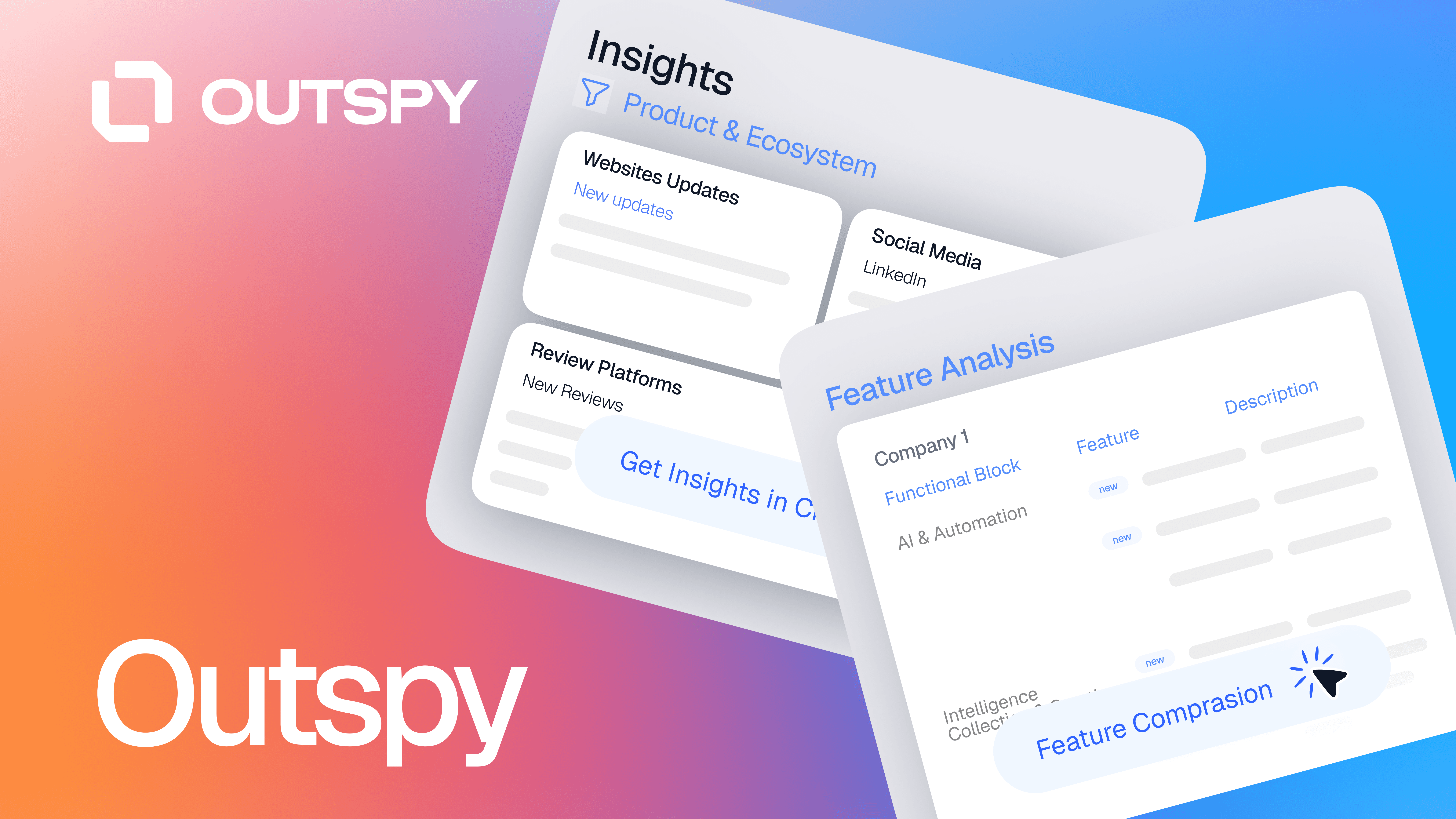
Outspy.ai is a specialized tool that focuses on the real-time, granular changes happening on a competitor's website. It uses AI to monitor, summarize, and deliver intelligence on feature launches, pricing shifts, and messaging changes.
Functionality & Focus
Outspy is built for teams who can’t afford to miss a single competitor move — product managers, strategists, marketers, and anyone responsible for understanding how their market shifts. The platform replaces hours of manual monitoring with continuous, AI-powered tracking of competitor websites, feature releases, pricing updates, and marketing activity.
Key Features
Pricing Trend Analysis: Specifically tracks and alerts on competitor pricing updates.
Competitive Dashboard: Provides a centralized view of all monitored competitors.
Feature Launch Alerts: Notifies users immediately when a new feature is detected.
Pricing
Outspy offers a 14-day free trial that gives users full access to the platform’s core capabilities, making it easy to test how the AI insights, competitor monitoring, and update tracking work in practice before committing.
For ongoing use, Outspy provides tiered paid plans, allowing startups and growing teams to choose the level of monitoring they need:
Starter: Around $9.99 for 3 Competitor Analyses per month.
Pro: Around $29.99 for 10 Competitor Analyses per month.
Business: Around $69.99 for 20 Competitor Analyses per month.
Advantages
All-in-One Monitoring: everything is captured and organized in one dashboard, reducing the need for multiple tools.
Actionable AI Insights: Outspy’s AI highlights meaningful changes, provides context, and helps teams understand what those updates might signal strategically.
Faster Decision-Making: By turning hundreds of pages of competitor content into concise insights, Outspy helps product and strategy teams react faster and with more confidence.
Tool 3: F5 Bot (Reddit Monitor)
F5 Bot is a simple yet powerful monitoring tool designed to track mentions of competitors, brands, and industry keywords across Reddit.
Functionality & Focus
Instead of analyzing websites or traffic patterns, F5 Bot focuses on real conversations happening in communities, giving teams access to unfiltered user opinions, emerging discussions, and early market signals that often don’t surface anywhere else. This makes it especially valuable for understanding how users talk about competitors in their own words.
Key Features
Keyword-based monitoring: Receive alerts whenever competitors or relevant terms appear in new Reddit threads or comments.
Real-time notifications: See new mentions as soon as they happen, allowing for quick reaction to emerging feedback or market shifts.
Community-level insights: Identify which subreddits actively discuss your category, competitors, or product type.
Pricing
F5 Bot is free to use, making it accessible for startups and small teams who want competitor awareness without investing in more complex social listening platforms.
Advantages
Unfiltered Customer Insights: Reddit provides raw, honest user discussions that offer a deeper understanding of competitor perception.
Fast Signal Discovery: Early mentions often reveal weaknesses, emerging needs, or dissatisfaction with competitor products.
Extremely Lightweight: No setup complexity — just add keywords and start receiving alerts.
Perfect Complement to Other Tools: Works alongside products like Outspy and SimilarWeb by covering the conversational layer of competitive intelligence that traditional platforms don’t capture.
Find Your Fit: Which Tool Works Best for Your Needs
Tool
Best For
Description
All-in-one competitor tracking (features, pricing, messaging, updates, insights)
The most complete tool: one dashboard for everything competitors change — features, prices, pages, and insights powered by AI
Traffic, channels, and audience behavior
Shows where competitors get their traffic and which marketing channels work for them
Real conversations and feedback on Reddit
Helps you see what people honestly discuss about competitors and the problems they raise
Conclusion
Most teams think of competitor research as something you do once: a spreadsheet, a quick search, maybe a few bookmarked links. But in reality, competitors change constantly, and so do customer expectations. That’s why having a mix of tools makes the process not just easier, but more accurate.
And the good news is that today’s tools make this work more accessible than ever. You don’t need a big budget or a dedicated research team — when you combine product updates, traffic data, and real user conversations, you gain a living, evolving understanding of your market.