Introduction
The rise of AI-powered search is changing how people discover brands. ChatGPT, Claude, Perplexity, and other Large Language Models (LLMs) are answering billions of questions monthly, often replacing traditional search engines.
Understanding how to analyze competitors' visibility in LLMs is becoming as crucial as tracking Google rankings. According to Gartner's 2024 prediction, search engine volume will drop 25% by 2026 due to AI chatbots.
This guide provides practical methods to analyze competitors' visibility in LLMs, what metrics matter, and how to improve your own AI discoverability.
What is LLM Visibility?
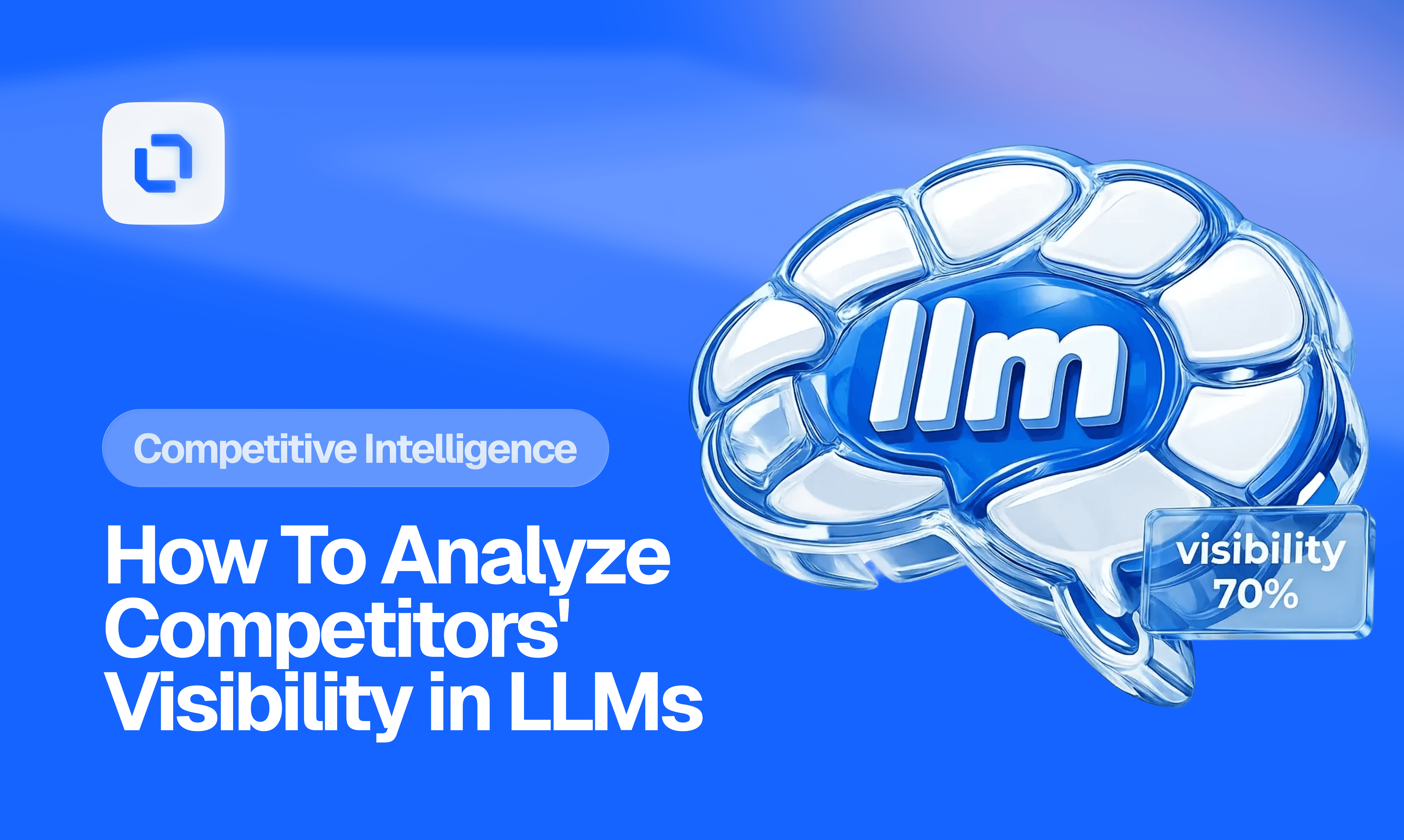
LLM visibility refers to how frequently and prominently your brand appears in AI-generated responses. When someone asks ChatGPT about "best project management tools" or queries Claude about "top email marketing platforms," LLM visibility determines whether your competitors get mentioned — and whether you do.
Unlike traditional search rankings, LLM visibility includes direct brand mentions, category inclusion in lists, context and positioning (positive/neutral/negative), citation frequency, and feature detail accuracy.
Research from Forrester on Generative AI's Impact on Search shows that 67% of consumers have used AI chatbots for product research, making LLM visibility directly tied to customer acquisition.
The Growing Importance of LLM Visibility
Users increasingly start and end research journeys within LLMs. Frequent mentions position your brand as an industry leader and influence the awareness stage of the buyer journey. If competitors appear in AI responses while you don't, you lose mindshare before prospects compare options.
The Critical Link Between LLM Visibility and Traditional SEO
LLM visibility isn't separate from SEO — it's an extension of it. AI models train on existing web content, meaning your SEO efforts directly influence LLM visibility. According to Search Engine Journal's research on AI and SEO, websites with strong E-E-A-T signals are more likely to be cited in AI responses.
Traditional SEO feeds LLM visibility through content quality, backlinks, brand mentions, structured data, and fresh content. This means analyzing competitors' LLM visibility should complement traditional competitive SEO analysis. Your competitors' AI visibility likely reflects their overall digital authority.
The New Reality: Ads Are Coming to AI
In January 2025, OpenAI announced that ChatGPT will begin displaying advertisements in chat conversations, starting with its search feature. This marks a significant shift in the LLM landscape — brands can now potentially buy their way into AI responses through paid placements.
However, this paid visibility option isn't universal. Anthropic, the company behind Claude, has explicitly stated it will not introduce ads. CEO Dario Amodei emphasized in multiple interviews that Claude will remain ad-free, focusing instead on subscription and enterprise revenue models.
Why This Makes Organic Visibility More Important
You Can't Buy Everyone: Even with ChatGPT accepting ads, multiple major LLM platforms remain ad-free. Perplexity has indicated it will limit advertising to maintain user trust, and Claude explicitly rejects the ad model. Focusing solely on paid placements in one platform leaves you invisible across others.
Paid vs. Organic Credibility: Users distinguish between sponsored content and organic mentions. When an LLM naturally recommends your brand based on its training data and web search, that carries more weight than a clearly labeled advertisement. This mirrors traditional search — organic rankings often drive more trust than paid ads.
Not All Queries Allow Ads: Even platforms that accept advertising will likely limit ad placements to specific query types or positions. Understanding how can you analyze your competitors' visibility in LLMs organically remains critical for queries where paid placement isn't available or appropriate.
Long-Term Cost Efficiency: Paying for visibility in every relevant query across multiple LLM platforms would be prohibitively expensive. Building genuine authority through content, backlinks, and brand mentions creates compounding returns without ongoing ad spend.
Cross-Platform Consistency: Your brand needs visibility across ChatGPT, Claude, Gemini, Perplexity, and future AI platforms. Organic visibility scales across all platforms automatically, while paid placements require separate negotiations and budgets for each.
The introduction of ads in some LLMs doesn't diminish the importance of organic visibility — it actually amplifies it. Brands that build authentic authority through quality content and genuine recognition will maintain visibility across the entire AI ecosystem, regardless of individual platforms' advertising policies.
This is why learning how can you analyze competitors' visibility in LLMs organically remains essential strategic work, even as paid options emerge.
Step-by-Step Guide: How To Analyze Competitors' Visibility in LLMs

Step 1: Identify Relevant Query Types
Determine which queries matter for your business:
Recommendation Queries: "What are the best [your product category]?"
Comparison Queries: "Compare [Competitor A] vs [Competitor B]"
Problem-Solution Queries: "How to solve [problem]"
Feature Queries: "Which [product] has [specific feature]?"
Use Case Queries: "Best [product] for [industry]"
Create 10-20 queries using your sales FAQ, search console data, and customer surveys.
Step 2: Manual Testing Across Multiple LLMs
Test on ChatGPT (with web search), Claude, Perplexity, Google Gemini, and Microsoft Copilot.
Document Results:
Query | LLM Platform | Competitors Mentioned | Your Brand Mentioned | Position in Response | Context (Positive/Neutral/Negative) | Citations Provided |
|---|---|---|---|---|---|---|
"Best CRM for startups" | ChatGPT | Salesforce, HubSpot, Zoho | No | N/A | N/A | Yes - 3 sources |
"Email marketing platforms" | Claude | Mailchimp, Constant Contact | Yes | 4th position | Positive | No |
Testing Protocol: Use incognito browsing, test each query 3 times over a week, screenshot responses, and note whether citations are provided.
Step 3: Use Specific Testing Prompts
Strategic prompts reveal deeper insights:
Prompt 1 - Direct Comparison:
Prompt 2 - Use Case Specific:
Prompt 3 - Feature-Based:
Prompt 4 - Alternative Testing:
Prompt 5 - Comprehensive Category:
These prompts maximize your chance of seeing all competitor mentions and understanding positioning.
Step 4: Analyze Patterns and Positioning
After collecting data, look for patterns:
Mention Frequency: Which competitors appear most consistently?
Position in Lists: Do they appear first, middle, or last?
Context Analysis: Are mentions positive, negative, or neutral?
Citation Patterns: Which websites are cited most often?
Feature Emphasis: Which strengths get highlighted?
Gaps and Opportunities: Which queries generate weak responses?
Step 5: Track Changes Over Time
LLM visibility isn't static. Set up a monitoring schedule:
Weekly: Test 3-5 core queries across primary platforms
Monthly: Comprehensive review of all query types
Quarterly: Deep analysis including new query variations
Create a tracking spreadsheet with timestamps to reveal month-over-month changes in competitor visibility.
Test with Different Phrasings: Try "best project management software," "top PM tools," and "leading project management platforms" separately because different phrasings reveal different competitors.
Use Temporal Queries: Add time qualifiers like "best [product] in 2025" to check if LLMs have recent competitor information.
Check for Hallucinations: If competitors are described with features they don't have, the LLM's information is outdated.
Test in Different Languages: If operating internationally, test in multiple languages. Visibility varies significantly across languages.
Ask Follow-Up Questions: After initial responses, ask "Tell me more about [competitor]" to reveal depth of LLM knowledge.
Common Mistakes to Avoid
Testing Only Once: LLM responses vary. Test multiple times over days.
Focusing Only on ChatGPT: Different LLMs have different training data. Test across platforms.
Ignoring Context: Being mentioned isn't enough. Negative mentions or last-place listings matter.
Neglecting Traditional SEO: LLM visibility stems from overall digital authority.
Expecting Immediate Changes: LLM training updates happen periodically. Improvements take time.
Conclusion
Learning how can I analyze my competitors' visibility in LLMs is essential in 2026's AI-first search landscape. By systematically testing queries across platforms, using strategic prompts, tracking mentions over time, and documenting patterns, you gain crucial competitive intelligence.
Remember that LLM visibility reflects your overall digital authority and traditional SEO strength. Competitors appearing in AI responses likely have strong backlink profiles, authoritative content, and consistent brand mentions.
FAQ
How can I analyze my competitors' visibility in LLMs for free?
Manually test queries across free LLM platforms like ChatGPT, Claude, and Perplexity. Create a spreadsheet to track mentions, positions, and context. This basic approach costs nothing but time. Test 10-15 queries weekly across 3 platforms, documenting results systematically. While not automated, this manual method provides actionable insights without paid tools.
What's the difference between LLM visibility and SEO rankings?
SEO rankings show where your website appears in search results for specific keywords. LLM visibility measures whether AI chatbots mention your brand when answering questions. SEO is position-based and trackable; LLM visibility is mention-based and more variable. However, they're connected — strong SEO often leads to better LLM visibility since AI models train on high-authority web content.
How often should I check competitors' visibility in LLMs?
Test core queries weekly and conduct comprehensive reviews monthly. LLMs update periodically, so daily checking adds little value. Weekly testing of 3-5 critical queries across main platforms provides sufficient trend data. Monthly deep dives should cover 15-20 query variations to catch visibility shifts and emerging patterns in competitor mentions.
Which LLM platform should I prioritize for competitive analysis?
Start with ChatGPT and Perplexity, as they have large user bases and active search features. Also test Claude and Google Gemini. Different platforms have different training data and may show varied competitor visibility. Testing across multiple platforms provides the most complete picture. Prioritize platforms your target audience actually uses for research.
Do LLMs favor certain types of content when mentioning brands?
Yes. LLMs tend to reference comprehensive guides, original research, expert opinions, and content from authoritative domains. List-style articles ("Top 10..."), comparison posts, and tutorial content are frequently cited. Content that earns many backlinks and mentions across reputable sites appears more often in LLM responses. Focus on creating genuinely valuable, in-depth content rather than promotional material.
Is LLM visibility more important than traditional SEO now?
No — they're complementary, not competitive. Traditional SEO remains crucial because it builds the foundation for LLM visibility. Search engines still drive massive traffic, and your SEO efforts directly influence AI training data. Invest in both: optimize for search engines while understanding how that work affects LLM visibility. Neglecting either limits your overall digital discoverability.