
Introduction
Today, successful companies don't just follow trends — they anticipate them. Competitive intelligence provides the radar needed to navigate a crowded market, enabling leaders to make decisions based on data. It has become a fundamental practice for any organization seeking to innovate, mitigate risk, and capture market share.
That's why businesses now use competitive intelligence — to systematically convert competitor and market data into actionable strategic moves.
This guide will walk you through what competitive intelligence is, why it’s indispensable, and how you can implement a systematic CI process, whether you’re a startup founder or a strategist in a global enterprise.
What is Competitive Intelligence?
A foundational step in CI is mapping your competitive landscape. This means looking beyond the obvious. You must identify both your direct competitors (those offering a nearly identical product/service to your target audience) and your indirect competitors (those solving the same core customer problem with a different solution).
In-Depth Study: We have detailed how to properly classify and analyze your direct and indirect competitors in our article: The Hidden Competition: How to Define Direct and Indirect Competitors.
Why is Competitive Intelligence Necessary?
Competitive intelligence is a fundamental necessity. It gives a business the ability to not just react to changes, but to shape them.
Risk and Uncertainty Reduction: CI helps identify potential threats, such as the launch of a competitor's new, disruptive product or a change in the regulatory environment. In fact, a 2024 industry report found that 67% of industry leaders rely on market intelligence to deepen competitor understanding and strengthen strategy. Knowledge is insurance against surprises.
Identification of Market Opportunities: By analyzing gaps in competitors' offerings, you can find "white spaces" in the market where your product can become unique. For example, if all competitors only serve the Enterprise segment, you might discover an opportunity for SMBs.
Optimization of Pricing and Positioning: CI provides data to justify your pricing strategy. You can know exactly where you stand relative to competitors and use that knowledge to create a compelling value proposition.
Product Improvement: Continuous monitoring of competitor features allows you to keep up with the market and, more importantly, innovate where competitors are stuck.
What Does Competitive Intelligence Include?
Competitive intelligence is a multi-faceted discipline that builds a 360-degree view of the competitive landscape. It systematically monitors several key pillars:
Intelligence Pillar | What It Tracks | Key Questions It Answers |
|---|---|---|
Product & Feature Intelligence | Product roadmaps, new features, UX/UI changes, technology stack, release notes. | What is their development priority? Where do they have a lead or a gap compared to us? |
Pricing & Packaging Intelligence | Pricing models, discount strategies, bundling, subscription tiers, contract terms. | How is our value perceived? Are we positioned as premium or budget? Where is their pricing vulnerable? |
Marketing & Sales Intelligence | Messaging, value propositions, content strategy, advertising campaigns, sales collateral. | What segments are they targeting? How are they generating leads? What is their key narrative? |
Market & Strategic Intelligence | New market entries, partnership announcements, M&A activity, funding rounds, leadership changes. | What is their long-term strategic direction? Where are they investing for growth? |
Tracking competitors’ digital ad spend, messaging, and performance is a massive source of insight. The tactics for this are evolving rapidly; here’s our practical guide: Digital Advertising Intelligence in 2026: A Practical Guide.
Who Needs Competitive Intelligence?
The short answer is every business, regardless of size or industry. The need is universal, but its application and focus differ significantly based on the organization's size, stage, and resources.
For Small Businesses & Startups: With limited resources for trial and error, CI is crucial for survival and niche-finding. Startups use it to understand incumbent weaknesses, position themselves effectively for investors and customers, and avoid direct, unsustainable clashes with larger players. It enables agile, evidence-based pivots.
For Large Enterprises: For established organizations, CI is essential for protecting hard-won market share, optimizing pricing strategies across regions, informing multi-million dollar M&A decisions, and monitoring disruptive entrants that could threaten core business lines. The scale requires systematized, often automated, intelligence gathering.
We have prepared detailed guides on applying CI in specific industries:
The Challenges Faced by Competitive Intelligence Practitioners
Building an effective CI function is not without its hurdles. Practitioners commonly face three core challenges:
Lack of Time: Manual collection and analysis are prohibitively time-consuming, pulling resources from strategic work.
Data Overload: The volume of publicly available information can be paralyzing, making it difficult to analyze and track.
Keeping Intelligence Relevant: Competitive insights quickly lose value if they are outdated, misaligned with current priorities, or not delivered at the moment teams actually need them.
To cope with limited time and the growing volume of data, CI teams are increasingly turning to AI to automate repetitive research tasks. This reduces the need for constant manual searches and data collection, allowing specialists to focus on understanding market trends, making sense of competitive moves, and contributing more directly to strategic decision-making.
Many teams, especially in startups, face the ‘zero budget’ challenge. The good news is, you can begin with a foundational research. Our guide shows you how: How to Conduct Market Research for a Startup on a Zero Budget.
How Do You Actually Do Competitive Intelligence? A Practical Framework
Step 1: Build Your Competitor List
First, know who you're watching. List direct rivals (same product, same buyers) and indirect ones (different approach, same customer pain). Rank them: top 5 get deep tracking, next 10 get light checks.
Step 2: Define What You Need to Know (What to Track)
Pick 3-5 metrics that directly impact your decisions right now. Here are the most common ones:
Pricing & Offers: Their current prices, discounts, and plan features.
Product Changes: New features, updates, or changes in their user interface.
Marketing Moves: Their current ad campaigns, key messaging, and content topics.
Customer Sentiment: What people are saying in recent reviews on G2, Capterra, or app stores.
Step 3: Assign a Owner and Set a Rhythm
This fails if it's "everyone's job." One person must lead.
The Owner: This is usually a Product Marketer, Growth Manager, or Product Manager. Their job is to run the process.
The Cadence:
Daily/Weekly: Get automated alerts (see Step 4).
Monthly: The owner compiles key findings into a 1-page update or a 10-minute team sync.
Quarterly: Do a deeper review to spot trends and update strategy.
Step 4: Collect and Centralize Data
You can do some manually, but not everything — tools make it scale without burnout.
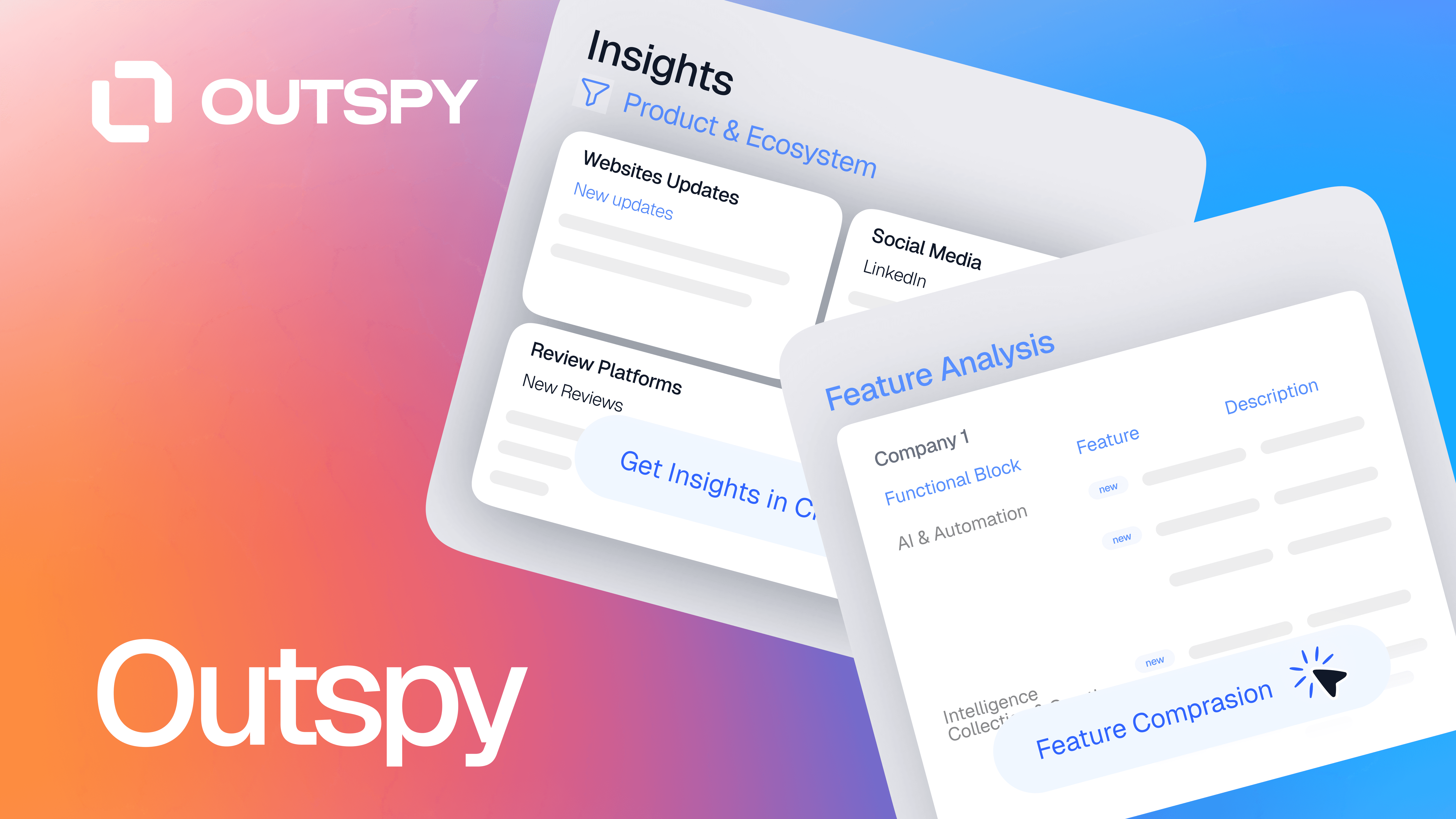
For All-Around Monitoring (The Best Starting Point): Use a platform like Outspy. You set it up once, and it automatically tracks competitor pricing, promotions, and ad campaigns, sending you alerts to a simple dashboard.
To see a detailed breakdown of Outspy's features and how to use it effectively, check out our dedicated article: Introducing Outspy: The Smarter Way to Monitor Competitors.
For Specific Deep Dives:
SEO & Content: Use Semrush or Ahrefs to see their keywords.
Social & News: Use Google Alerts or Brand24 to track mentions.
We've tested and selected the top 3 tools for tracking competitors' business activities. See the detailed breakdown here: Top 3 Tools To Track Your Business Competitors in 2026.
Step 5: Turn Data into Decisions
Schedule Regular "Competitor Sync" Meetings.
Block a recurring 30-minute meeting every two weeks with key players from Product, Marketing, and Sales. This isn’t for deep analysis — it’s for alignment. Use this time to:
Share the top 3 competitor changes from your dashboard.
Discuss: "What does this mean for us?"
Decide on one small, immediate adjustment.
Brainstorm Using Insights as Hypotheses.
Don't just report facts —use them as springboards for ideas. When your tools flags that a competitor is heavily promoting a specific feature, turn it into a hypothesis for your team:
Tool Insight: Two competitors released native integrations with the same third-party platform within a single quarter.
Your Hypothesis: This integration may be becoming a category standard. In customer interviews, we should validate whether its absence is already perceived as a blocker.
Conclusion
It empowers organizations to move from being reactive to becoming proactive, from guessing to knowing. By building a systematic, ethical CI practice, you gain the clarity to navigate market complexities, seize opportunities your competitors miss, and make strategic decisions with confidence.
The field of CI itself is evolving - the competitive intelligence tools market is forecast to increase by USD 27.95 billion, accelerating at a CAGR of 9.5% between 2024 and 2029.
To stay ahead of the methodology curve, be sure to explore the latest competitive intelligence trends and the article on how AI is transforming marketing to understand both the future landscape and the key technologies redefining it.
FAQ (Frequently Asked Questions)
Q: What is competitive intelligence in simple terms?
A: It is a systematic process of monitoring and analyzing competitors' activities using publicly available information. This includes tracking their pricing, product updates, marketing campaigns, and customer sentiment to inform your own business strategy.
Q: What are the main goals of competitive intelligence?
A: The core goals are to reduce risk, identify opportunities, and support strategic decisions. Specifically, CI aims to anticipate competitor moves, uncover market gaps, benchmark your performance, avoid surprises, and ultimately drive profitable growth through informed action.
Q: What tools are best for competitive intelligence?
A: The best tool depends on your specific goal. For comprehensive, automated monitoring of competitor pricing, promotions, and digital marketing tactics, an all-in-one platform like Outspy is highly effective, as it centralizes data and sends real-time alerts. If your focus is narrower — for example, SEO or content gap analysis — a specialized tool like Semrush is powerful, though it often requires more manual setup and interpretation.
Q: What are the most important data sources for competitive intelligence?
A: The most important sources are competitors' websites, their job postings, financial reports (for public companies), press releases, social media, and customer reviews on third-party platforms.
Q: How long does the competitive intelligence process take?
A: CI is a continuous process, not a one-time event. Data collection can be automated by tools, but analysis and conversion of data into strategic insights require constant attention from an analyst.
Q: Who in the company should be responsible for competitive intelligence?
A: It can be anyone in strategy, marketing, product, or a dedicated CI function. Crucially, it should be a cross-functional effort where insights from sales, marketing, and product teams are centralized and analyzed.